Zmago Jeraj "Horizons"
May 9. 2012 - June 25. 2012 (7 p.m.) 0: 1: 2: 3: 4:This overview exhibition of Zmago Jeraj’s works made between 1969 and 2011 puts on view drawings, paintings, prints, photographs, and objects that depict landscapes with horizons, done in a variety of techniques and approaches.
The selection includes minimalist and geometric paintings and prints as well as photographs taken in recent years, in which the artist returns to landscapes with horizons that cannot be seen, but only guessed at or intuited.
Horizons, the lines seemingly dividing the land from the sky, are present in many different ways in Zmago Jeraj’s art. In the photographs from the 1960s and the 1970s, the horizon is obscured, with only the foreground being clearly visible.
The series of photographs of dumping grounds are from the 1970s. These shots had a decisive influence on the paintings of biomorphic still lifes composed of garbage in infinite landscapes. The former empty spaces are here replaced by dead landscapes, again with gray horizons. Wastelands are inhabited by leafless trees. Individual tree trunks are marked with diagonal lines, as though indicating prohibition. Geometric gashes reminiscent of open graves intrude in the landscapes. The overall appearance is of the ultimate end. The light in the paintings and the photographs is similar: dull, impenetrable, not revealing anything. Among the last in this series is a painting with a red background, a red sky.
The series of dead landscapes is followed by a series of line drawings. Similar parallel lines are repeated, producing the appearance of multiple horizons. Such forms would mark the decade to come – lines that look jagged or shaky, creating the illusion of spatiality in the figures and objects. Also the spaces, when drawn or indicated with lines, seem as if the world were only just composing, coming alive, or perhaps falling apart. They are representations of single moments within longer periods.
The line remained a crucial element in Jeraj’s art in the years that followed. The new feature was the white background in drawings or paintings. Similarly as in the series “Drawings Just Like That”, the works are about events in people’s lives, events in which the actual happening or the reasons for it cannot be fathomed. Yet the lines, indicating the direction of light or the figures’ movements, acquire a dramatic meaning and nature, like in a comic strip. When drawn against a dark surface, the sense of mystery intensifies. There is an undertone of expectation, of waiting for the end. The images look like freeze-frames from a movie.
Miloš Bašin (From the tekst in catalogue)
_
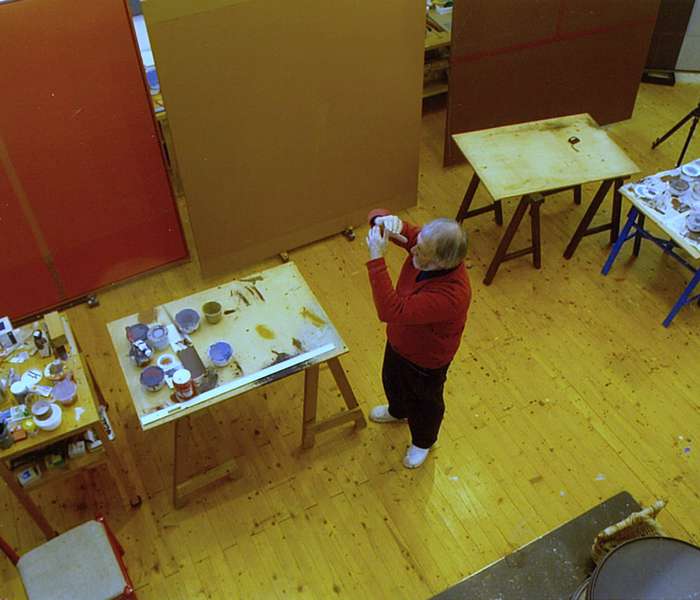
Zmago Jeraj was born on November 9, 1937 in Ljubljana. In 1955 he went to study painting at the Academy of Fine Arts in Ljubljana, transferring to the Academy of Fine Arts in Belgrade in 1958, and graduating in 1960 with a degree in painting under Prof. Zora Petrović. He obtained his MFA in painting from the Academy of Fine Arts in Ljubljana under Prof. Gabrijel Stupica in 1967.
In 1969 he received a British Council scholarship to pursue postgraduate studies in printmaking under Prof. Ian Fraser at the Hornsey College in London. In 1996 he began teaching drawing and painting at the Academy of Fine Arts in Ljubljana. Jeraj works in the fields of painting, drawing, printmaking, photography, and set and book design. He is also involved in critical writing, editing publications, and art education.
In 2009 he received the Prešeren Prize for Lifetime Achievement.
He lives in Maribor, Slovenia.
Horizons, the lines seemingly dividing the land from the sky, are present in many different ways in Zmago Jeraj’s art. In the photographs from the 1960s and the 1970s, the horizon is obscured, with only the foreground being clearly visible.
The series of photographs of dumping grounds are from the 1970s. These shots had a decisive influence on the paintings of biomorphic still lifes composed of garbage in infinite landscapes. The former empty spaces are here replaced by dead landscapes, again with gray horizons. Wastelands are inhabited by leafless trees. Individual tree trunks are marked with diagonal lines, as though indicating prohibition. Geometric gashes reminiscent of open graves intrude in the landscapes. The overall appearance is of the ultimate end. The light in the paintings and the photographs is similar: dull, impenetrable, not revealing anything. Among the last in this series is a painting with a red background, a red sky.
The series of dead landscapes is followed by a series of line drawings. Similar parallel lines are repeated, producing the appearance of multiple horizons. Such forms would mark the decade to come – lines that look jagged or shaky, creating the illusion of spatiality in the figures and objects. Also the spaces, when drawn or indicated with lines, seem as if the world were only just composing, coming alive, or perhaps falling apart. They are representations of single moments within longer periods.
The line remained a crucial element in Jeraj’s art in the years that followed. The new feature was the white background in drawings or paintings. Similarly as in the series “Drawings Just Like That”, the works are about events in people’s lives, events in which the actual happening or the reasons for it cannot be fathomed. Yet the lines, indicating the direction of light or the figures’ movements, acquire a dramatic meaning and nature, like in a comic strip. When drawn against a dark surface, the sense of mystery intensifies. There is an undertone of expectation, of waiting for the end. The images look like freeze-frames from a movie.
Miloš Bašin (From the tekst in catalogue)
_
Zmago Jeraj was born on November 9, 1937 in Ljubljana. In 1955 he went to study painting at the Academy of Fine Arts in Ljubljana, transferring to the Academy of Fine Arts in Belgrade in 1958, and graduating in 1960 with a degree in painting under Prof. Zora Petrović. He obtained his MFA in painting from the Academy of Fine Arts in Ljubljana under Prof. Gabrijel Stupica in 1967.
In 1969 he received a British Council scholarship to pursue postgraduate studies in printmaking under Prof. Ian Fraser at the Hornsey College in London. In 1996 he began teaching drawing and painting at the Academy of Fine Arts in Ljubljana. Jeraj works in the fields of painting, drawing, printmaking, photography, and set and book design. He is also involved in critical writing, editing publications, and art education.
In 2009 he received the Prešeren Prize for Lifetime Achievement.
He lives in Maribor, Slovenia.
back to the list