Magnum's First: The Face of Time
May 29. 2012 - September 2. 2012 0:Magnum’s First: The Face of Time is the very first group exhibition of Magnum Photos which is considered a photographic myth of the 20th century, time and again inspiring new generations of photographers.
Until just recently, it was thought that the earliest group exhibition of Magnum photographers was the one curated by Fritz Gruber for the photokina in Cologne in 1956 … but then a spectacular discovery was made in 2006.
The first stop for the show was in June and July 1955 at the Institut Français in Innsbruck. Its next station was very appropriate: the Würthle Gallery in Vienna, where Gesicht der Zeit was shown in late September. The arrangements were probably made with the help of influential Viennese sculptor Fritz Wotruba, who had been operating the famous art gallery since 1953, and also kept up a correspondence with Henri Cartier-Bresson. Between October 1 and 16 the show was presented in Bregenz. Another stop was the Joanneum in Graz, where a gallery space was provided between January 21 and February 5, 1956. Thanks to the initiative of a well-established local amateur photographers’ club, 21 the Joanneum agreed to host the show. The final station was probably the Neue Galerie in Linz, which returned the exhibition pieces to Innsbruck on February 17 where in 1956 it sank into oblivion in the cellar of the French cultural centre for exactly half a century. In 2006, this superb collection of original vintage photographs was rediscovered, restored and exhibited in Vienna.
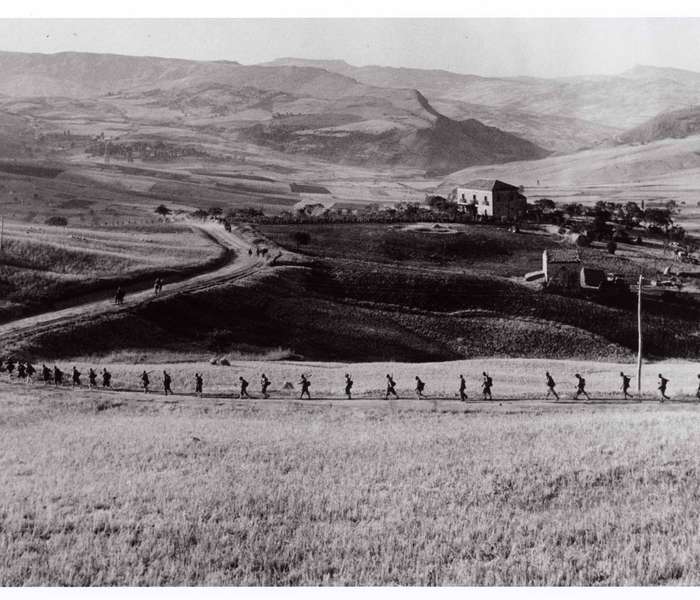
The selection of Magnum’s First exhibition includes 83 original black-and-white vintage photographs by world renowned photographers, including, among others, the founders of Magnum Photos: Robert Capa, Marc Riboud, Werner Bischof, Henri Cartier-Bresson, Ernst Haas, Erich Lessing, Jean Marquis and Inge Morath.
The photographs by Henri Cartier-Bresson depict the last days in the life of the great Indian leader Gandhi and his funeral. Ernst Haas is the author of the photographic story on the making of Howard Hawks’ monumental epic film The Land of the Pharaohs in 1955. Genuine images of London’s high society during the early 1950s are captured in a series of photographs by the Austrian artist Inge Morath, whilst the French photographer Marc Riboud managed to catch the carrying of a large portrait of Tito amidst the bustle of Dalmatian streets. Robert Capa, who might well be considered the most famous photojournalist of all time, contributed three photographs of the Basque Country to Magnum’s first exhibition, whereas the most exotic are the images from the photographic diary of Werner Bischof taken in Peru, Chile, Japan, Cambodia ... Erich Lessing and Jean Marquis are again presented with images taken from an environment closer to us, the former with photographs of Viennese children and the latter with vedutas from Hungary.
MAGNUM PHOTOS
Founded two years after the end of World War Two, Magnum was formed by five committed photojournalists (Robert Capa (1913–1954), David Seymour (1911–1956), George Rodger (1908–1995), Henri Cartier-Bresson (1908–2004) and William Vandivert (1912–1989)) who, deeply influenced by the apocalyptical time, were well aware of the immense power of the medium in which they recorded events they encountered on their way. They aimed to present people in their actual environments and conditions. They believed in photojournalism as a medium capable of raising awareness, educating and thereby contributing to a better world. Apart from rejecting sensationalism they advocated the principle of supranationality. It was this attitude that enabled Magnum Photos to distance itself from both national and ideological stereotypes which often result in bloodshed of global dimensions. We might call this attitude “photographic humanism”: it has decisively marked the world history of photography and laid the foundations for photojournalism, which is indispensable in recording everyday images of times both past and present.
Magnum Photos was initially an exclusive club, limited to a maximum of ten members.These days, the circle of photographers whose membership is extended every two years has widened. During the 55 years of its active existence, it facilitated many superb photojournalists to work in all parts of the world, thereby making an indelible impression on the visual memory and our knowledge about the inhabitants of our civilisation.
In cooperation with Photonic moments – Month of Photography 2012.
THE PROGRAMME ACCOMPANYING THE EXHIBITION
Guided tours in the English language: on Saturdays at 4:30 p.m., included in the entry fee.
Guided tours for schools and other groups upon request, price €3 / 2 € per person.
Museums on a Summer Night, 16 June 2012
The Jakopič Gallery open from 10 a.m. till midnight. Free entry. Guided tours in the Slovenian language at 11 a.m. and 7 p.m.
Wednesday, 30 May, at 6 p.m.: A lecture by Marco Bischof, the son of photographer Werner Bischof, and Andréa Holzherr, Exhibition manager at Magnum Photos
PHOTO COMPETITION
Captured moments recorded by press photography tell stories about people and the time they lived in. Put yourself to the test as a photojournalist and capture the pulse of Ljubljana, Vienna, London, Dalmatia, Hungary and India. Your photographs may go down in history!
You can read the rules for the photo competition here.
The first stop for the show was in June and July 1955 at the Institut Français in Innsbruck. Its next station was very appropriate: the Würthle Gallery in Vienna, where Gesicht der Zeit was shown in late September. The arrangements were probably made with the help of influential Viennese sculptor Fritz Wotruba, who had been operating the famous art gallery since 1953, and also kept up a correspondence with Henri Cartier-Bresson. Between October 1 and 16 the show was presented in Bregenz. Another stop was the Joanneum in Graz, where a gallery space was provided between January 21 and February 5, 1956. Thanks to the initiative of a well-established local amateur photographers’ club, 21 the Joanneum agreed to host the show. The final station was probably the Neue Galerie in Linz, which returned the exhibition pieces to Innsbruck on February 17 where in 1956 it sank into oblivion in the cellar of the French cultural centre for exactly half a century. In 2006, this superb collection of original vintage photographs was rediscovered, restored and exhibited in Vienna.
The selection of Magnum’s First exhibition includes 83 original black-and-white vintage photographs by world renowned photographers, including, among others, the founders of Magnum Photos: Robert Capa, Marc Riboud, Werner Bischof, Henri Cartier-Bresson, Ernst Haas, Erich Lessing, Jean Marquis and Inge Morath.
The photographs by Henri Cartier-Bresson depict the last days in the life of the great Indian leader Gandhi and his funeral. Ernst Haas is the author of the photographic story on the making of Howard Hawks’ monumental epic film The Land of the Pharaohs in 1955. Genuine images of London’s high society during the early 1950s are captured in a series of photographs by the Austrian artist Inge Morath, whilst the French photographer Marc Riboud managed to catch the carrying of a large portrait of Tito amidst the bustle of Dalmatian streets. Robert Capa, who might well be considered the most famous photojournalist of all time, contributed three photographs of the Basque Country to Magnum’s first exhibition, whereas the most exotic are the images from the photographic diary of Werner Bischof taken in Peru, Chile, Japan, Cambodia ... Erich Lessing and Jean Marquis are again presented with images taken from an environment closer to us, the former with photographs of Viennese children and the latter with vedutas from Hungary.
MAGNUM PHOTOS
Founded two years after the end of World War Two, Magnum was formed by five committed photojournalists (Robert Capa (1913–1954), David Seymour (1911–1956), George Rodger (1908–1995), Henri Cartier-Bresson (1908–2004) and William Vandivert (1912–1989)) who, deeply influenced by the apocalyptical time, were well aware of the immense power of the medium in which they recorded events they encountered on their way. They aimed to present people in their actual environments and conditions. They believed in photojournalism as a medium capable of raising awareness, educating and thereby contributing to a better world. Apart from rejecting sensationalism they advocated the principle of supranationality. It was this attitude that enabled Magnum Photos to distance itself from both national and ideological stereotypes which often result in bloodshed of global dimensions. We might call this attitude “photographic humanism”: it has decisively marked the world history of photography and laid the foundations for photojournalism, which is indispensable in recording everyday images of times both past and present.
Magnum Photos was initially an exclusive club, limited to a maximum of ten members.These days, the circle of photographers whose membership is extended every two years has widened. During the 55 years of its active existence, it facilitated many superb photojournalists to work in all parts of the world, thereby making an indelible impression on the visual memory and our knowledge about the inhabitants of our civilisation.
In cooperation with Photonic moments – Month of Photography 2012.
THE PROGRAMME ACCOMPANYING THE EXHIBITION
Guided tours in the English language: on Saturdays at 4:30 p.m., included in the entry fee.
Guided tours for schools and other groups upon request, price €3 / 2 € per person.
Museums on a Summer Night, 16 June 2012
The Jakopič Gallery open from 10 a.m. till midnight. Free entry. Guided tours in the Slovenian language at 11 a.m. and 7 p.m.
Wednesday, 30 May, at 6 p.m.: A lecture by Marco Bischof, the son of photographer Werner Bischof, and Andréa Holzherr, Exhibition manager at Magnum Photos
PHOTO COMPETITION
Captured moments recorded by press photography tell stories about people and the time they lived in. Put yourself to the test as a photojournalist and capture the pulse of Ljubljana, Vienna, London, Dalmatia, Hungary and India. Your photographs may go down in history!
You can read the rules for the photo competition here.
Virtual exhibition
Magnum's First: The Face of Time
Andréa Holzherr, exhibition manager at Magnum Photos, responsible for popularisation of Magnum's archives, told us a few interesting stories about Magnum photographers.
Magnum's First: The Face of Time
Marco Bischof, the son of photographer Werner Bischof, one of the first members of Magnum, came to see the exhibition in Jakopič Gallery.
back to the list